NoteMacro
AI is building assets the debt markets can’t price
The AI build-out is the clearest sign yet that debt-based plumbing cannot fund productive capacity, and that a new market structure is forming.
For forty years, the world’s financial plumbing has run on debt. Mortgages, corporate bonds and government securities are pooled, rated, traded and pledged as collateral, the asset a borrower hands over to back a loan. That system is deep and fast, and it is now financing the largest capital build-out in a generation.
It deserves credit for that. The money for AI data centers is being raised, and it is being raised quickly.
But the assets AI produces do not fit the plumbing that funds them. A data center full of chips is not a promise to repay. It is a machine that does work, and its value depends on how much work it does. The debt markets can only price it through the balance sheet of whoever owns it.
This piece makes one argument: the AI build-out shows that debt-based finance cannot properly price or fund productive capacity, and that a new market for capacity is the next step. It sets out what the last era built, what AI is building, what the price signals say, and what the missing market needs.
What the last era built
The last era’s achievement was turning debt into a tradable asset. In the 1980s, home loans became securities once they could be pooled and rated. Corporate credit and government bonds followed the same path into deep, liquid markets.
At the base of that structure sits government debt. It is the collateral of last resort and the benchmark that every other loan is priced against. That base is getting more expensive to carry. Data from the US Bureau of Economic Analysis show federal interest payments of about $1.28 trillion a year in Q2 2026, more than double the Q4 2019 level.
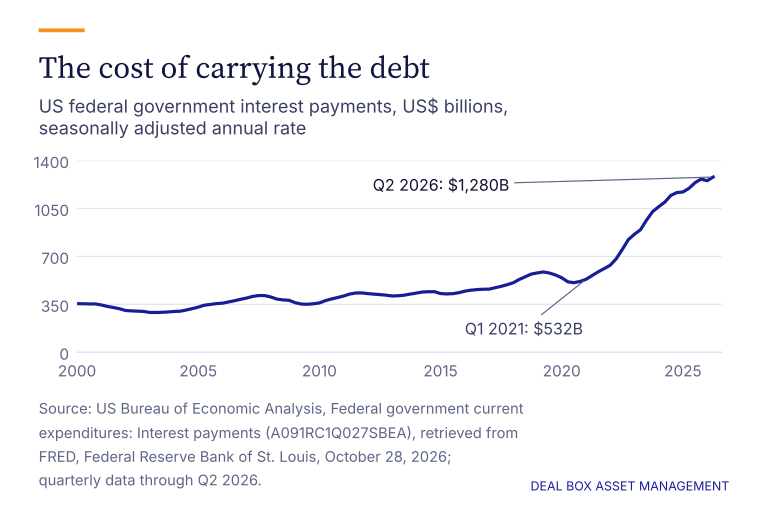
Every new demand for capital now competes with that bill. AI is the largest new demand in decades.
What AI is building
What AI produces is productive capacity: assets whose value comes from the work they do. A cluster of chips sells compute by the hour. A trained model earns fees each time it is used. A fleet of warehouse robots moves a counted number of boxes.
These assets share three traits. Their output can be measured continuously. Their useful lives are measured in years, not decades. And their income depends on use, not on a borrower’s promise.
Debt markets are built for the opposite profile. A bond is a fixed claim on a borrower, priced on the borrower’s credit. So when a lender funds a data center, it underwrites the tenant and the sponsor, not the machines. The output that gives the asset its value stays out of view.
The result is concentration. Capacity gets financed only where a large balance sheet can stand behind it. Bloomberg reports (October 28, 2026) that at least 18 data-center financings now carry double-digit yields, a sign that lenders are charging heavily for risk they cannot see into.
What the prices say
If the plumbing were pricing capacity well, markets would broadly agree on what it is worth. They do not. Bridgewater Associates estimates (September 2026) that AI equities discount about 3.5% annual US productivity growth, while consensus forecasts and broader markets imply about 1.5% to 2%. Greg Jensen, Bridgewater’s Managing CIO, puts it plainly: “Either AI stocks or broader macro markets are very meaningfully mispriced.” His case is set out in Bridgewater’s global outlook and excerpted in Edward Conard’s Macro Roundup.
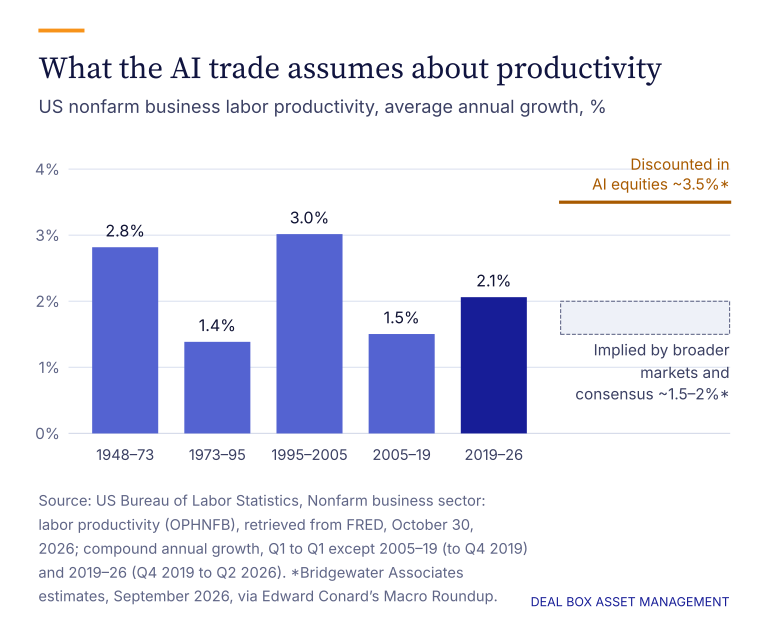
The firm reads the gap differently. In its view, the disagreement is less about whether AI works than about where its value can be held. Equity markets can capture it only through a handful of listed companies. Bond markets see the borrowing, not the output.
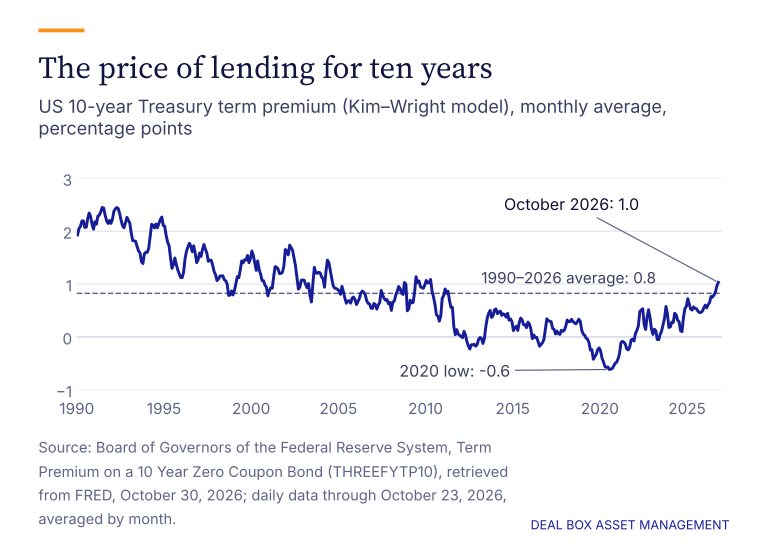
The bond market’s own price makes the point. The term premium is the extra yield lenders demand to lock up money for ten years rather than roll it over. Federal Reserve data put it near 1.0 percentage point in October 2026, slightly above its average of about 0.8 since 1990. A system bracing for a long fight over capital would likely charge more.
The missing market
A market for capacity needs three things the debt plumbing lacks.
First, verification. A lender should be able to confirm that a machine exists, is running and is earning, from a record it can check directly rather than through audits months later.
Second, ownership in small units. A share of a compute cluster’s output should be as easy to hold and transfer as a bond, so capital can reach capacity without passing through one large balance sheet.
Third, settlement at any hour. Machines run around the clock. Claims on their output should clear the same way.
The firm calls this an economic operating system: a shared set of rails for contracts, ownership and settlement that anyone can check at any time. As it argued in “The next thing Wall Street learns to price,” an asset becomes financeable once it is measurable, verifiable and transferable.
“The disagreement is less about whether AI works than about where its value can be held.”
Why Bitcoin
Rails for capacity need a base that no single party controls. Today’s base is government debt, which is a promise from an issuer whose costs are rising. In the firm’s view, Bitcoin is the natural alternative. Its supply is fixed by design, it has no issuer, foundation or operator, and its ledger has run continuously for more than fifteen years.
On such rails, productive capacity can be financed and settled against neutral collateral instead of being added to the stack of corporate and sovereign debt.
Consider how that could work for a compute cluster. The cluster reports its usage and income to a public record. A lender checks that record directly and extends credit against the output, with Bitcoin posted as collateral where needed. A buyer could hold a small share of that output and sell it on a Sunday. None of this requires the owner to be one of a handful of large listed companies. That is the market structure the AI build-out is missing.
The objection, and the firm’s answer
The strongest objection is that credit markets have financed every past build-out, from railroads to fiber, and are financing this one. New rails, on this view, solve a problem that does not exist.
The firm agrees that existing markets will carry most of the AI build-out. Its point is about what they miss. Double-digit yields on data-center loans and a wide gap between equity and macro pricing are what an asset looks like when it cannot be verified directly. If the AI payoff disappoints, the case for neutral, verifiable collateral grows stronger, not weaker.
Questions for the investment committee
- Do we know how the AI build-out we hold through public markets is financed, and by whom?
- Does our digital-asset strategy treat Bitcoin only as a price, or also as collateral and settlement?
- Which productive assets in our world would become financeable if their output could be verified?
If any answer is “not sure,” that is a conversation worth having with the family’s own advisers.
The pattern
Each era of finance began with an asset the old system could not price. American railroads raised money in the nineteenth century once lenders could hold bonds backed by track and rolling stock. Home loans became securities in the 1980s once they could be pooled and rated. AI’s output now faces the same test. The firm may be wrong about the rails, the base asset or the timing, and adoption may come more slowly than the build-out needs. But the gap between what AI produces and what debt markets can price is real, and it is widening. The last era financialized debt. The next financializes productive capacity.
Sources
Bridgewater Associates, Greg Jensen and Jim Haskel, “Managing CIO Greg Jensen Shares Our Global Outlook.”
Edward Conard, Macro Roundup, “Change Is Accelerating Because It’s All Interconnected,” excerpting Greg Jensen of Bridgewater Associates, October 30, 2026. Bridgewater figures cited are its estimates as of September 2026.
Bloomberg, Neil Callanan, Caleb Mutua and Paula Doenecke, “Wall Street’s AI Debt Machine Is Starting to Choke on Supply,” October 28, 2026, via Yahoo Finance.
US Bureau of Labor Statistics, Nonfarm business sector: labor productivity (output per hour) for all workers (OPHNFB), retrieved from FRED, Federal Reserve Bank of St. Louis, October 30, 2026.
Board of Governors of the Federal Reserve System, Term Premium on a 10 Year Zero Coupon Bond (THREEFYTP10), retrieved from FRED, Federal Reserve Bank of St. Louis, October 30, 2026.
US Bureau of Economic Analysis, Federal government current expenditures: Interest payments (A091RC1Q027SBEA), retrieved from FRED, Federal Reserve Bank of St. Louis, October 28, 2026.
Deal Box Asset Management, Dylan Carter, “The next thing Wall Street learns to price,” October 28, 2026.
Neither Bridgewater Associates, Edward Conard nor Bloomberg has reviewed or endorsed the views here, which are Deal Box Asset Management’s own.
About the author
Dylan Carter is Managing Partner of Deal Box Asset Management and Director of Corporate Affairs at Deal Box, Inc. Deal Box works with companies building Bitcoin-based financial infrastructure, so he has a direct interest in the theme of this piece.
Deal Box Asset Management is being formed. It publishes research on digital assets, tokenization and the infrastructure connecting them to regulated finance.
Principal risks
The thesis above is a forward-looking view and may prove incorrect.
- Technology: Bitcoin and related protocols may fail, be compromised or behave in ways not previously observed.
- Adoption: institutions may adopt other systems, or adopt this one more slowly than anticipated.
- Market: digital assets are highly volatile and may lose all of their value.
- Regulatory: changes in law or regulation may restrict or alter the use of digital assets.
This material is not investment advice or an offer to buy or sell any security. See Disclosures for material risks, or Contact the firm with questions.