NoteNew collateral
The next thing Wall Street learns to price
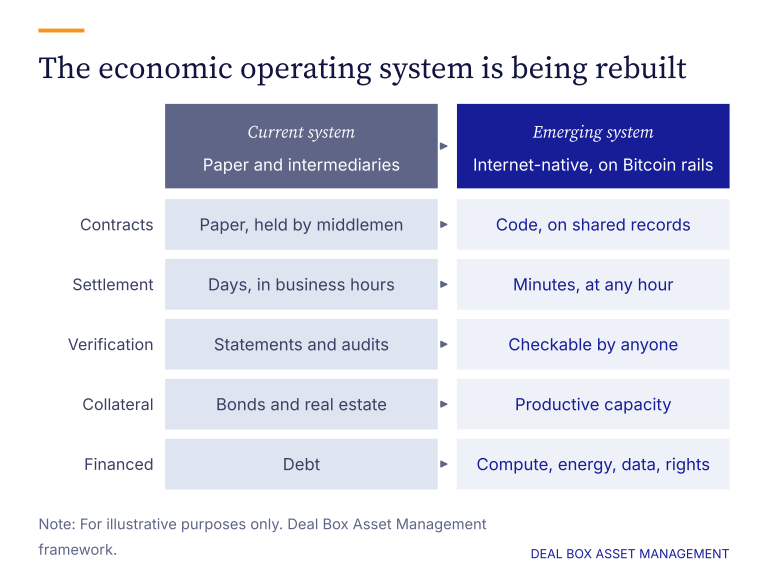
The last era financialized debt. The next one financializes productive capacity.
The financial system that most capital runs on today took its modern shape in the 1980s. Over that decade, Wall Street learned to bundle mortgages into securities, slice loans into collateralized debt obligations, and write derivatives on almost anything with a price. Later, the cloud and big data turned information itself into an asset. The result is deep, liquid and trusted, and it has earned the capital it carries.
But it runs on paper contracts, layers of intermediaries and settlement that stops on weekends, and it finances mostly one thing: debt. The key insight of each earlier wave is that an asset becomes financeable only once it becomes measurable, verifiable and transferable. A new set of assets is now crossing that line, and the AI build-out is showing where the incumbent system struggles to price them.
“Every financial era starts when something ordinary becomes verifiable. That’s when it becomes financeable.”
This piece makes one argument: Bitcoin is the most credible base layer for an economic operating system that runs on the internet, and that system will finance productive capacity the way the last one financed debt. It surveys the strain, the collateral problem beneath it, eight candidates for what gets financialized next, and the base layer.
The strain
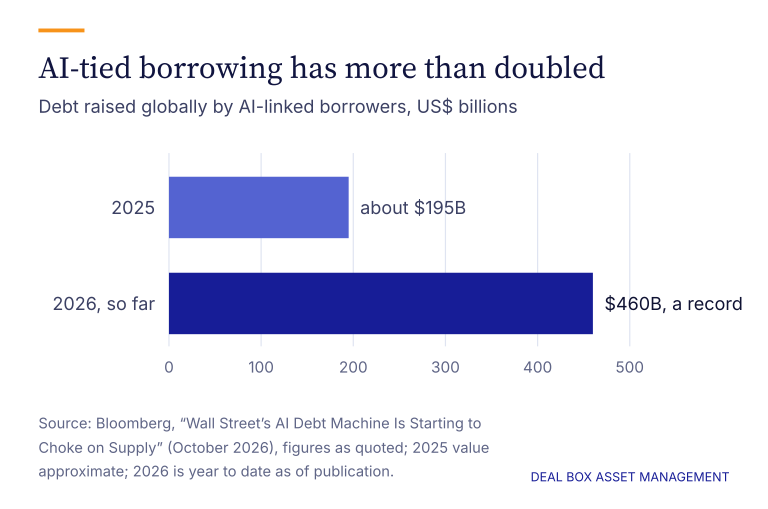
According to Bloomberg, firms have raised a record $460 billion in AI-tied debt globally so far in 2026, compared with about $195 billion in 2025, and a bigger share of it is junk-rated. Quarterly cash raised through long-term debt by the largest AI builders reached about $135 billion in a single 2026 quarter, after years of mostly staying under $40 billion.
Buyers are getting choosier. Bid-to-cover ratios on hyperscaler debt are declining, at least 18 data-center financings carry double-digit yields, and Volta Infrastructure’s $5 billion loan priced above 11%. Five-year credit default swaps, the cost of insuring a company’s debt against default, are at records for Oracle (near 300 basis points), SpaceX, Nvidia and Meta. The Bloomberg IG Tech index now yields about 6%, up 1.4 percentage points in a year.
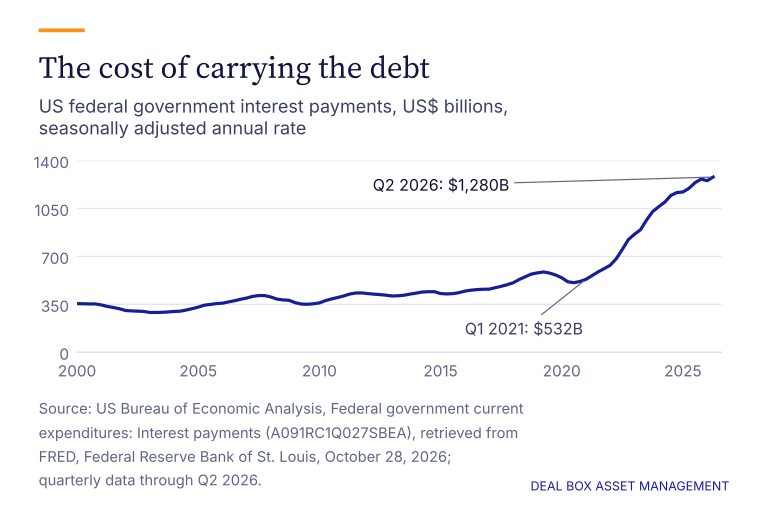
The strain is not confined to AI borrowers. US federal interest payments ran at an annual rate of about $1.28 trillion in the second quarter of 2026, up from about $532 billion in the first quarter of 2021, according to the Bureau of Economic Analysis. A system built on debt is paying more to carry it.
The collateral problem
The size of the borrowing is not the deeper issue. The deeper issue is that lenders struggle to price and verify what the debt is secured by.
Consider what a lender must do to underwrite a loan against a GPU. It has to estimate how fast the chip loses value, confirm where it sits as it moves between data centers, and judge how often it will actually be rented, since it earns money only when it is. Traditional loan paperwork was not designed for any of that. Double-digit yields are, in part, the price of that uncertainty.
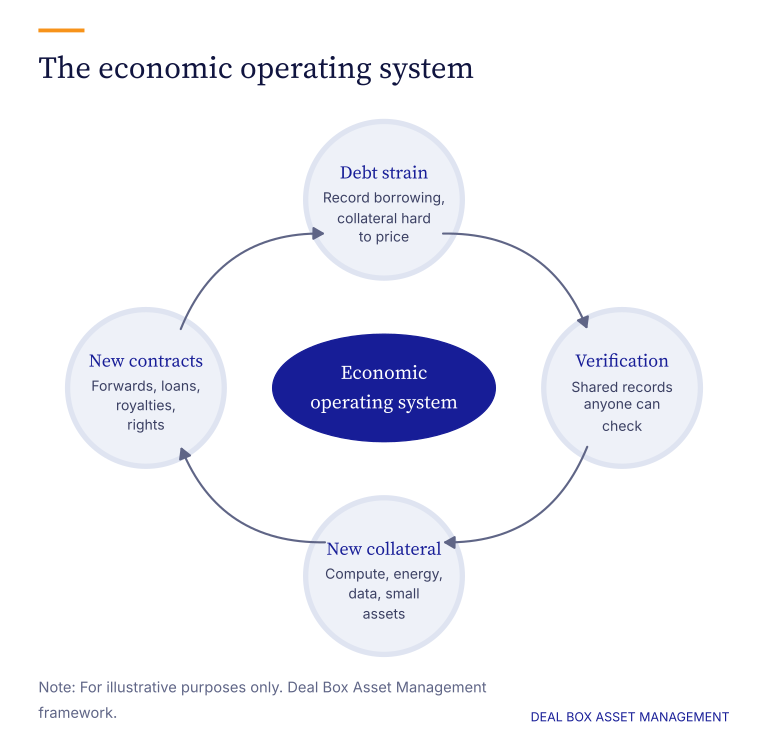
Internet-native contracts change the order of operations. When an asset reports its own usage and income to a shared record that anyone can check, verification comes first and pricing follows. That is the cycle in Figure 4: strain in the old system creates demand for verification, verification turns new things into collateral, and new collateral makes new contracts possible.
Eight candidates
What gets financialized next? Each candidate already produces value but has been hard to measure, verify or transfer.
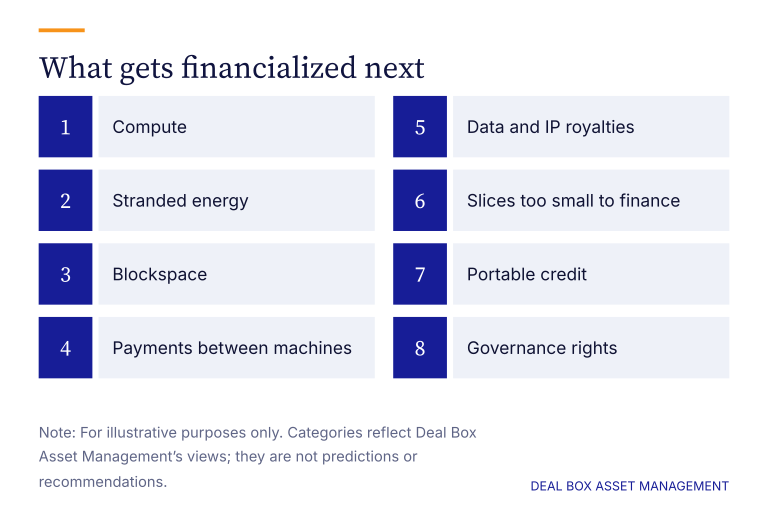
Compute
Computing power is becoming a commodity, like oil or electricity. GPU hours can trade the way commodities do, with forward contracts that lock in a price for future capacity and loans backed by the compute itself. This has already begun. In 2023, CoreWeave raised $2.3 billion in debt collateralized by Nvidia chips, and in 2024 it signed a $7.5 billion facility with Blackstone as lead. As IFR reported, a Blackstone executive said, “No one had ever financed GPU chips before.”
Stranded energy
Plenty of power is generated where nobody can use it, or at hours when nobody wants it. Bitcoin mining can switch on and off and can be located almost anywhere, which makes it a buyer of last resort for that energy. Texas miner Riot Platforms, for example, earned $31.7 million in power and demand-response credits in August 2023 by powering down during a heat wave. A power site with a reliable flexible buyer is easier to finance.
Blockspace
Every blockchain has limited room for transactions, and most of it is sold on the spot. Delphi Digital’s October 2026 research on ETHGas sets out how institutions could instead buy defined execution conditions in advance, much as airlines sell seats or utilities sell capacity. Forward-sold capacity would let a fund plan a large rebalance with a known cost and timing.
Payments between machines
AI agents are starting to buy data, compute and software on their own. Coinbase’s x402 protocol lets software pay for an API call automatically over the web, with no account or card. Once machines pay each other, they need credit lines, spending limits and insurance: a new financial product.
Data and IP royalties
A song, a dataset or a patent produces income over time, usually reported in slow, opaque royalty statements. Programmable contracts can turn that income into a stream that pays out automatically and can be split, sold or borrowed against.
Small assets
Many good assets have been too small to finance: a minority stake in a private company, one season’s harvest from a vineyard, a single invoice. Legal and settlement costs swallowed the deal. When ownership and settlement move onto shared rails, those costs fall, and assets can be sliced and settled far more cheaply.
Portable credit
A credit history mostly lives inside one country’s bureaus and one bank’s files. A record of payments that anyone can verify, with the owner’s permission, could travel with a person or business anywhere, and open underwriting to borrowers the current system cannot see.
Governance rights
Votes, approvals and decision rights have value, but they are rarely priced. On an economic operating system, governance can be recorded, delegated or pledged like any other right, and become part of an asset’s value rather than a footnote to it.
The base layer
Each of these contracts needs the same three things: a shared record anyone can check, settlement that runs at any hour, and a base asset that is not someone else’s promise. In the firm’s view, Bitcoin is the most credible foundation for that, because no single company or government controls it and its record has run continuously for more than fifteen years. Other networks and stablecoins will play roles on top, but an operating system needs a neutral base.
Questions for the investment committee
Family offices do not need to predict which of these markets wins. They need a view. Three questions belong on the agenda:
- Is our digital-asset exposure only price exposure, or do we understand the contracts being built on these rails?
- Which of our businesses or holdings produce something (compute, energy, data, royalties) that could become collateral?
- Who on our team can explain the economic operating system to our family or board in five minutes?
If any answer is “not sure,” that is a conversation worth having with the family’s own advisers.
The pattern
It is difficult to predict which of these markets will mature first, or how quickly. But the historical pattern is consistent. Mortgages, corporate loans and then information each became financeable once they could be measured, verified and transferred at scale, and each time the contracts built on top mattered more than the first asset to move. If that pattern holds, the larger story of the next decade is not a single coin. It is what the economic operating system lets the world finance.
Sources
Bloomberg, “Wall Street’s AI Debt Machine Is Starting to Choke on Supply,” by Callanan, Mutua and Doenecke, October 2026.
US Bureau of Economic Analysis, Federal government current expenditures: Interest payments (A091RC1Q027SBEA), retrieved from FRED, Federal Reserve Bank of St. Louis, October 28, 2026.
Delphi Digital, “ETHGas: Institutional Blockspace on Ethereum,” October 2026.
Opening structure inspired by Delphi Digital’s Macro Regime (v2) report. Public company examples are linked in the text. Neither Bloomberg nor Delphi Digital has reviewed or endorsed the views here, which are Deal Box Asset Management’s own.
About the author
Dylan Carter is Managing Partner of Deal Box Asset Management and Director of Corporate Affairs at Deal Box, Inc. Deal Box works with companies building Bitcoin-based financial infrastructure, so he has a direct interest in the theme of this piece.
Deal Box Asset Management is being formed. It publishes research on digital assets, tokenization and the infrastructure connecting them to regulated finance.
Principal risks
The thesis above is a forward-looking view and may prove incorrect.
- Technology: Bitcoin and related protocols may fail, be compromised or behave in ways not previously observed.
- Adoption: institutions may adopt other systems, or adopt this one more slowly than anticipated.
- Market: digital assets are highly volatile and may lose all of their value.
- Regulatory: changes in law or regulation may restrict or alter the use of digital assets.
This material is not investment advice or an offer to buy or sell any security. See Disclosures for material risks, or Contact the firm with questions.